
Lesson 17 · Advanced · 15 min
Chain complex tasks: break workflows into sequenced stages
Break complex deliverables into three chained prompts. Master data handoffs between milestones to ensure consistent executive deliverable rigor.
- Goal
- You will decompose complex workflows into sequential prompt pipelines with intermediate checkpoints to deliver robust, audit-grade deliverables.
- Skills
- Steer

Attempting to resolve intricate enterprise assignments within a single monolithic prompt inevitably degrades model performance. Chaining prompts breaks complex workflows into coordinated stages: first extracting verified facts, then evaluating operational trade-offs, and finally drafting executive deliverables while strictly filtering intermediate data between turns.
1The staging airlock: decoupling analytical thinking from prose drafting
The staging airlock decouples analytical thinking from prose drafting. Dividing work into sequential stages prevents the model from trading factual accuracy for polished narrative flow.
When an AI model is asked to extract data points, evaluate operational risks, and draft an executive briefing within a single query, it conducts these tasks simultaneously inside an unverified processing chain. Breaking work across three distinct prompts establishes human inspection gates where you validate facts before commanding final prose generation.
Pipeline stage Operational role Intermediate deliverable Human verification checkpoint Stage 1: Extraction Inventories raw facts from reference files Data table with zero prose Confirm metrics match source documents Stage 2: Assessment Computes variances and scores options Weighted decision matrix Validate scoring criteria with team leads Stage 3: Drafting Synthesizes approved findings for leadership 150-word executive briefing Calibrate tone and final recommendations 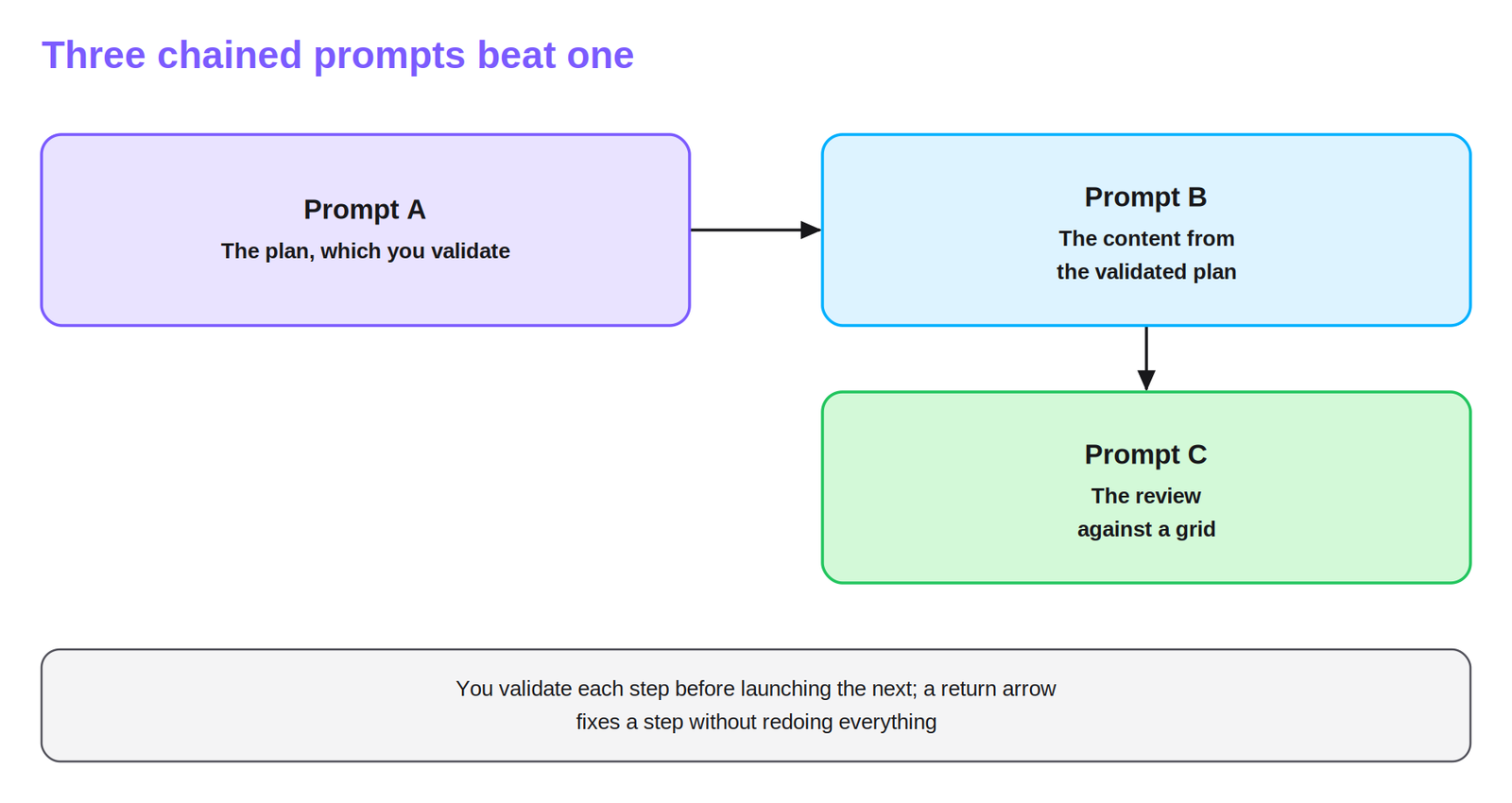
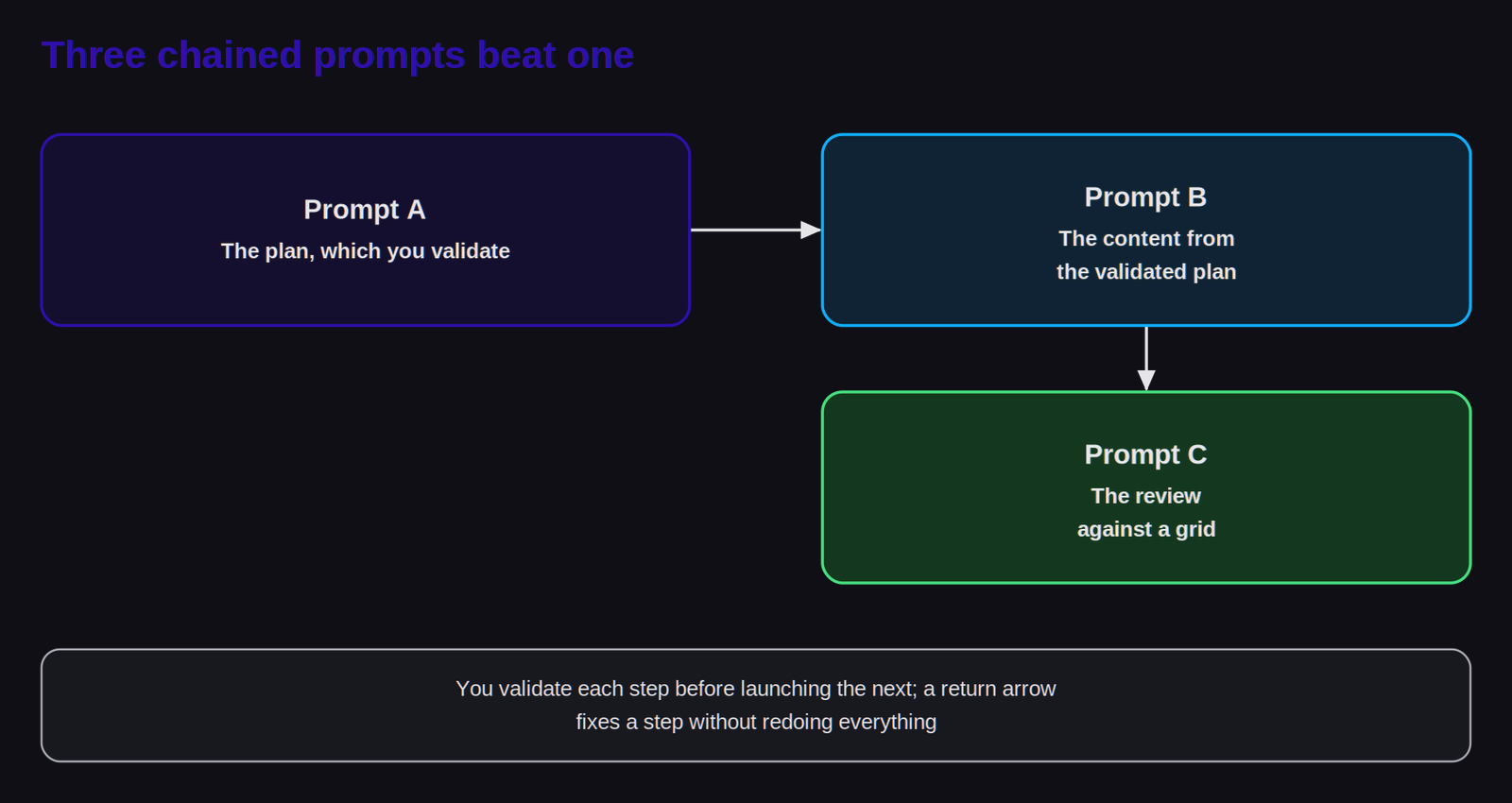
Diagram 'Chaining complex tasks'Diagram generated by AI and reviewed 2Generating an executive market assessment via 3 sequential prompts
Generating an executive market assessment via 3 sequential prompts demonstrates why chained workflows produce superior strategic deliverables compared to unconstrained one-shot queries.
A corporate development analyst must build an expansion memo on European sovereign cloud adoption.
Weak prompt.
Write a complete market analysis on European sovereign cloud providers with key metrics, competitors, and our strategic plan.Gemini generates a 1,000-word overview that sounds impressive but blends verified market facts with ungrounded marketing projections.
Strong prompt.
Stage 1: Based strictly on the attached industry reports, extract into a 3-column table the 5 leading sovereign cloud vendors, their estimated market share, and 2024 revenues. Output no conversational introduction or concluding remarks.The difference. The analyst audits Stage 1 data, executes Stage 2 to calculate growth rates, and uses Stage 3 to draft the final executive briefing from verified numbers.
3Construct an audit-grade 3-step prompt pipeline
Constructing an audit-grade three-step prompt pipeline trains you to master sequential multi-stage prompting architectures required for high-stakes strategic analyses.
Consider this consultation briefing from NovaTech Ltd:
'Tender Data - NovaTech Ltd: Sovereign cloud hosting evaluation 2026. Vendor A (Sovereign Certified): £42,000/yr, 99.95% SLA, 24/7 managed operations included, 6-week migration window. Vendor B (Regional Provider): £29,000/yr, 99.8% SLA, business-hours support, 10-week migration window. Vendor C (European Multi-region): £46,000/yr, 99.99% SLA, dual ISO27001 and Healthcare certified, 4-week migration window. Strict budget cap: £45,000/yr.'
Execute this sequenced pipeline across 3 gated turns:
- Extraction (Stage 1): 'Stage 1/3: Extract data for all 3 vendors into a 5-column comparative table (Vendor, Annual Cost, SLA, Support, Migration Time). Do not include conversational remarks. Await my confirmation.'
- Analysis (Stage 2): 'Stage 2/3: Using the validated table, disqualify any vendor exceeding the budget cap and score the remaining candidates out of 10 based on SLA-to-cost efficiency.'
- Synthesis (Stage 3): 'Stage 3/3: Draft an 80-word executive investment memorandum recommending the preferred vendor with numerical justification.'
Self-evaluation rubric: (a) each stage generates a clean, reusable deliverable; (b) human validation eliminates non-compliant options at the intermediate checkpoint; (c) the final executive memo relies exclusively on verified numbers.
4Passing noisy raw context between stages instead of purified artifacts
Passing noisy raw context between stages instead of purified artifacts clutters downstream context windows and causes attention drift across sequential turns.
Copying an entire 500-word conversational response into the next prompt injects conversational pleasantries and secondary digressions. The downstream prompt then expends attention processing low-value text.
Fix: sanitize intermediate outputs before feeding them to subsequent prompts, passing forward only the verified data table or bullet points.
Rule to remember: chained prompt pipelines perform best when each step receives only the distilled essence of earlier stages.
5Quiz
Three questions, instant feedback. Each option comes with an explanation.
6Proof of mastery
Submit a 3-step prompt chain sequence demonstrating the production of a workplace deliverable, documenting intermediate validated milestones.

Criteria


Going further
Review glossary definitions for prompt chaining, task decomposition, and AI pipeline. The next lesson, Gemini prompt library for teams, shows how to catalog prompt chains. Explore Meta-prompt and advanced optimization for next-level prompt design.
Frequently asked questions
Why avoid demanding the final product in one comprehensive prompt?
A monolithic prompt forces the LLM to simultaneously handle evidence retrieval, strategic synthesis, and prose styling. Sequential chaining cuts cognitive load, yielding vastly superior work.
What data should be passed between chain milestones?
Carry forward only the purified deliverable of the preceding stage (a validated table or structured bullet list), never conversational detritus or raw context.
How many stages make up an effective pipeline?
Three stages are typically optimal: 1. Extraction and scoping; 2. Analysis and strategic evaluation; 3. Executive formatting and prose polishing.