
Lesson 8 · Intermediate · 15 min
Analyzing Documents and Files with ChatGPT
Analyze business files with ChatGPT: spreadsheets, PDF records, and memos. Extracting key metrics, targeted summaries, and data safety precautions.
- Goal
- You will upload business documents to ChatGPT, extract critical metrics, and verify the accuracy of cited factual excerpts.
- Skills
- Check

Document analysis in ChatGPT enables direct querying of PDF reports, spreadsheets, and extensive business agreements. Combining digital text extraction with OCR vision, the engine isolates critical terms and synthesizes complex records. To maintain legal defensibility, always demand verbatim quotations coupled with exact page citations for every extracted claim.
1Document ingestion and targeted extraction in ChatGPT
Document ingestion and targeted extraction in ChatGPT turns hours of manual document review into structured analytical dialogues. When a file is uploaded, the platform parses text layers, indexes core passages, and injects relevant snippets directly into the attention window.
With extensive records, the system may exhibit reduced focus on clauses located in the middle sections. Enforcing mandatory verbatim citations with page references compels the language model to locate the physical source before generating findings.
Document Format Ingestion Pipeline Core Advantage Operational Precaution Digital PDF Direct text layer parsing High throughput and layout fidelity Verify multi-column text ordering Scanned PDF Optical Character Recognition Unlocks legacy archived paperwork Scrutinize ambiguous numerals Excel / CSV Tabular parser or Python Structured aggregation and sorting Run Code Interpreter for exact sums Word (.docx) Structural hierarchy reader Native heading and list preservation Strip private internal draft comments 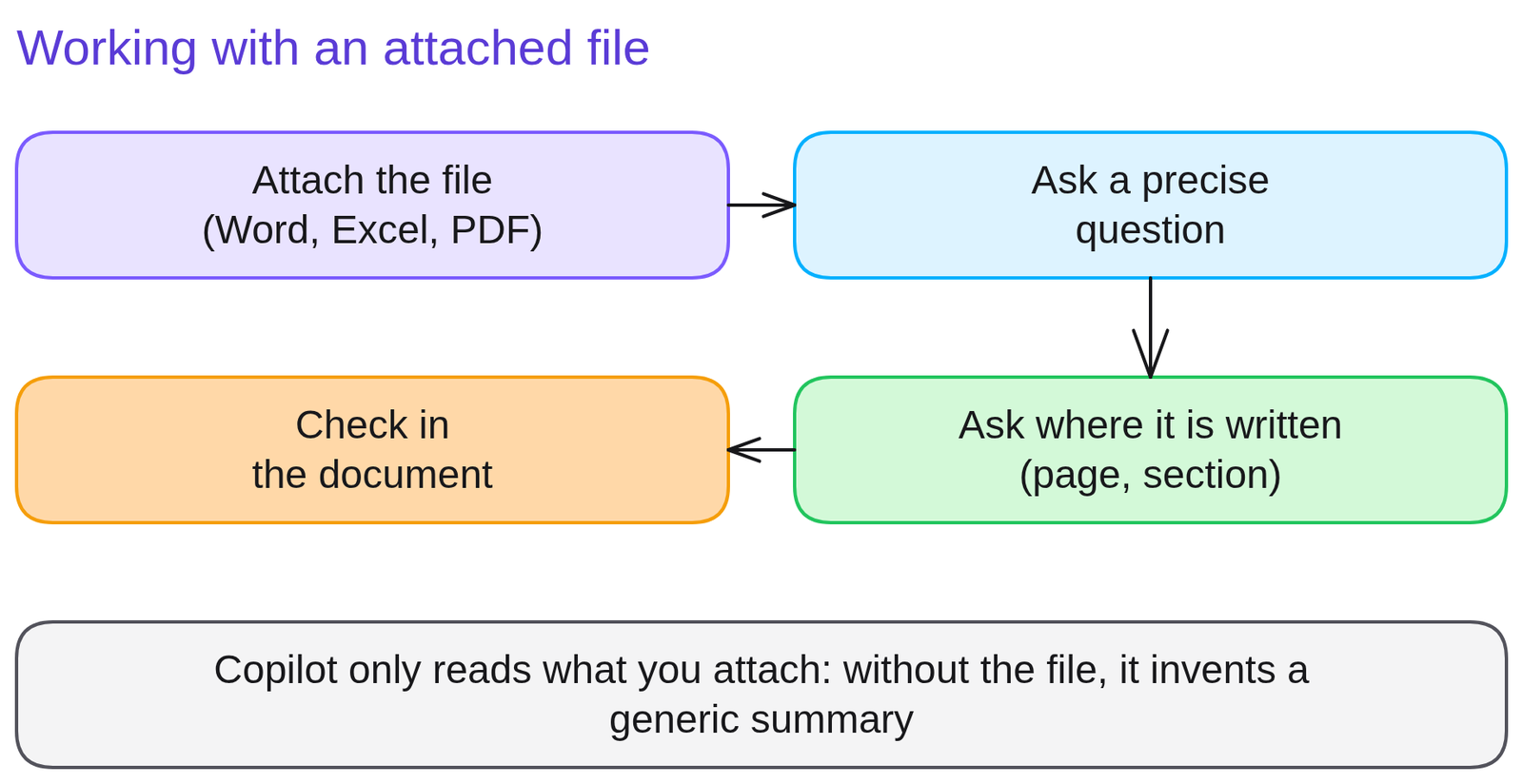
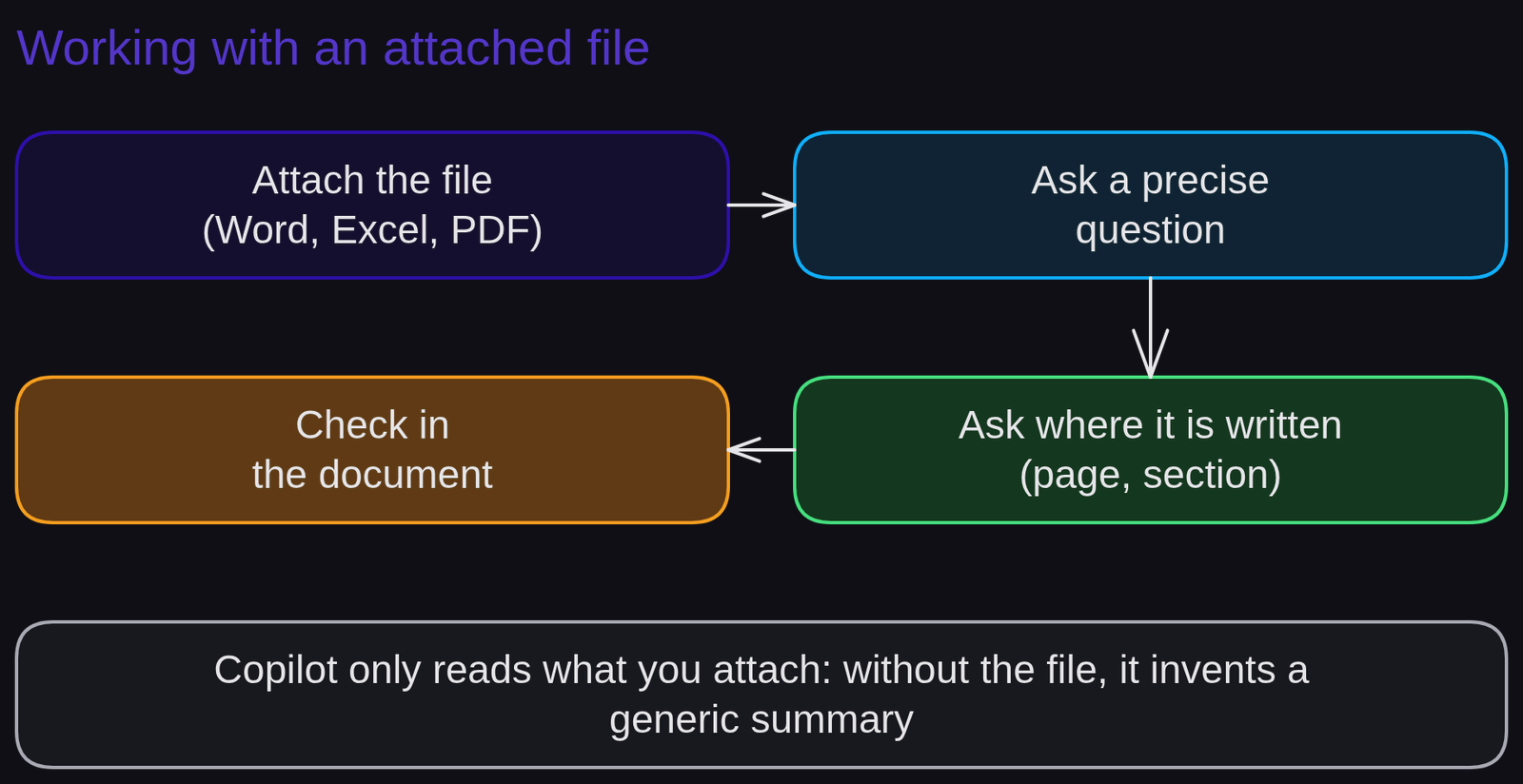
Diagram of document analysisDiagram generated by AI and reviewed 2Auditing an annual PDF report to extract critical ratios
Auditing an annual PDF report to extract critical ratios eliminates manual data entry mistakes while preserving full auditability back to official financial notes.
An ESG analyst assesses a contractor's annual report to evaluate greenhouse gas disclosures.
Weak prompt.
Review the attached PDF and tell me the company's carbon emissions.The model yields an aggregate figure without clarifying Scope boundaries or citing document locations.
Strong prompt (Turn 1).
Context: ESG audit of the attached annual PDF. Task: Extract the 2024 greenhouse gas inventory into a 4-column table: Emissions Scope (Scope 1, 2, 3), Emissions (Metric Tons CO2e), Year-over-Year Delta, and Source Page Number. Absolute rule: Quote the exact sentence verifying each reported metric.The model extracts reported data cleanly with verifiable page references.
Turn 2: Capital expenditure audit follow-up.
To uncover underlying capital commitments without losing context, the analyst follows up:
From the same document, list in a three-column table the capital expenditure planned for decarbonizing the transport fleet: Initiative, Allocated Budget 2025-2026, Page. If an amount is not stated, write "not specified".ChatGPT extracts the three budget lines without speculating, referencing the exact financial disclosure notes.
What changes. The initial prompt enforces strict accounting boundaries. The follow-up deepens the inquiry into actual investments without starting from scratch.
3Extract contractual obligations from a business agreement
Extract contractual obligations from a business agreement to practice employing ChatGPT as a dependable legal pre-review assistant.
To practice without handling sensitive records, here is an anonymized master services excerpt (fictional company NovaTech Ltd), ready to copy or save into
logistics_agreement.docx:[Logistics Services Agreement Excerpt - NovaTech Ltd (Fictional Training Sample)] Article 3 - Service Level Agreements (SLA): The service provider guarantees monthly order platform availability of 99.5%. Article 4 - Dispatch Timelines: All orders validated before 2:00 PM must ship on the same business day. In the event of delays exceeding 48 hours not caused by force majeure, a fixed delay penalty of €150 excl. VAT per calendar day is credited against the monthly invoice. Article 5 - Data Residency & Security: Order tracking logs must reside exclusively within the European Union. (Audit Note: this contract contains no stipulations governing end-of-contract data reversibility or transfer protocols).The "Load exercise" button in the composer pre-fills the objective with the weak starting prompt:
"Analyze this attached contract and list the provider's obligations."
From this starting point, complete the prompt with the composer. Define the legal counsel role and require a four-column table: article, obligation, verbatim quote, and delay penalty.
Enable the "not found" fallback for unstated terms, particularly data reversibility. Apply the end-instruction technique (arXiv:2307.03172) by placing your questions at the end to prevent attention loss across documents.
Self-evaluation rubric: (a) document ingestion proceeds without error; (b) contractual articles and delay penalties are accurately identified with verbatim citations; (c) the absent reversibility clause correctly returns "not found".
4Exceeding context bounds or assuming the entire file was memorized
Exceeding context bounds or assuming the entire file was memorized leads analysts to miss critical conditional waivers buried deep in contract exhibits.
Across a 120-page document, attention models may capture executive summaries effectively while missing a pivotal liability clause placed on page 64.
Correction: for lengthy files, segment queries across specific chapters: 'Restrict your audit to Chapter 4 regarding Off-Balance Sheet Commitments (pages 55 to 70)'.
Rule to remember: as document length increases, prompt directives must pinpoint the exact section to inspect.
5Quiz
Three questions, instant feedback. Each option comes with an explanation.
6Proof of mastery
Upload a workplace document and produce a rigorous extraction featuring three verbatim quotes with their respective page references.

Criteria


Going further
Review glossary definitions for context window and hallucination. Proceed to lesson 9: Multimodal ChatGPT vision and images. For processing large datasets with mathematical precision, explore Advanced Data Analysis with Python.
Frequently asked questions
Which file formats can ChatGPT ingest directly?
ChatGPT processes PDF documents, Word files (.docx), Excel spreadsheets (.xlsx, .csv), slides (.pptx), and plain text formats (.txt, .md, .json).
How does ChatGPT extract information from a PDF?
The system parses digital text layers and performs internal semantic retrieval. For scanned PDFs without text layers, it utilizes native OCR vision models.
Are uploaded files stored indefinitely in your account?
Files remain tied to the active chat conversation thread until deleted. In Team and Enterprise workspaces, they remain shielded within organizational boundaries.